PERFORMANCE & CHARACTER OF RUBBER FLOORING
Material Introduction
Rubber flooring refers to flooring made of high molecular weight materials such as natural rubber, synthetic rubber, and other components. Natural rubber refers to rubber harvested from artificially cultivated rubber trees. Synthetic rubber is an accessory product of petroleum, including butadiene styrene, high benzene, butadiene rubber, etc. In terms of appearance, rubber flooring has bright and bright colors, and a texture as soft as rubber, especially suitable for laying in sports venues. As a new type of flooring material, rubber flooring has gradually gained popularity in the market due to its high-quality environmental performance, innovative production technology, and diverse and charming colors.
PERFORMANCE & CHARACTER
Rubber flooring mainly uses synthetic rubber, natural rubber, and other polymer materials, with a soft texture, wear-resistant and anti slip properties, bright colors, easy laying, and easy cleaning, which is very different from traditional flooring.
Specifically, rubber flooring has the following characteristics:
(1) Green and environmentally friendly: non-toxic and harmless, non polluting to the environment, and free of radioactive elements;
(2) Waterproof and anti slip: it becomes astringent when in contact with water, which can eliminate the safety concerns of the elderly and children; Does not deform when in contact with water, effectively inhibits the growth of harmful bacteria;
(3) Lightweight and thin: reduces the load-bearing capacity of buildings, making it the best choice for high-rise buildings
(4) Easy and fast paving: Rubber flooring is easy to lay and can be glued onto a flat, hard, clean, and dry surface with a suitable adhesive. There is no dust, dirt, or obvious construction noise on the construction site, and it will not pose a threat to the surrounding environment;
(5) Super wear-resistant: The wear-resistant layer on the surface can withstand a large amount of trampling and has a long service life;
(6) Silent and comfortable: impact resistant, elastic, good sound absorption, comfortable foot feel;
(7) Acid and alkali resistance: resistant to acid and alkali corrosion, able to withstand harsh environmental tests;
(8) Thermal insulation: Good thermal conductivity, uniform heat dissipation, no cold feeling of ceramic tiles; The coefficient of thermal expansion is small, making it suitable for cold northern regions.
Product Process and Classification: TECH&CATEGORY
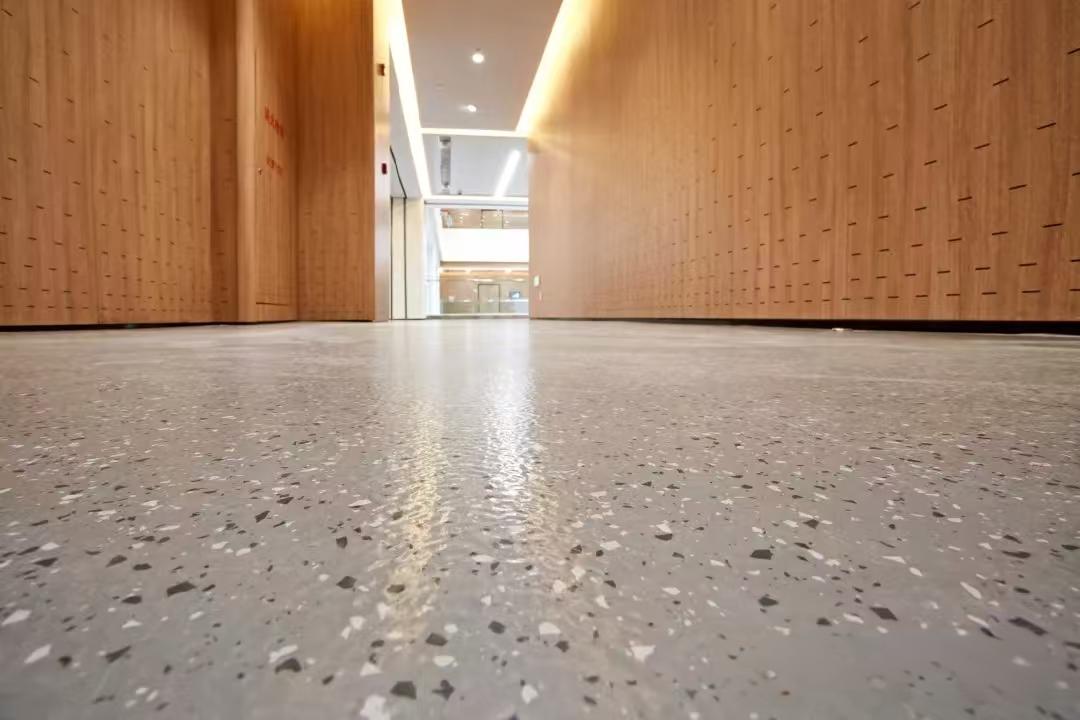
Rubber flooring, as a new type of flexible flooring material, can be made into patterns of stone, terrazzo, and wooden flooring through different manufacturing processes. Moreover, rubber flooring has a variety of colors and novel patterns, which can be matched in various ways. Therefore, it is widely used in commercial areas with high traffic such as hospitals, supermarkets, exhibition halls, garages, gyms, etc
And industrial floor space. The types of rubber flooring include: homogeneous transparent flooring, cut composite flooring (i.e. sheet), sports flooring, anti-static flooring, etc.
(1) Homogeneous transparent flooring: Its hardness is no less than ceramic tiles, and it is also very thin, so it has a wide range of applications. However, its requirements for the floor are very high, and the material price is not cheap.
(2) Sheet metal: also known as printed bricks, beautiful colors are one of its major features, and simple construction and wide applicability are its main advantages. At present, except for school libraries and hospitals, sheet materials are almost used on all indoor floors.
(3) Sports flooring: All standard sports venues, gyms, and dance rooms generally use sports flooring.
(4) Anti static floor: also known as dissipative static floor or square tube stool, when it is grounded or connected to any lower potential point, it will dissipate the charge.
Common parameters COMMON
Hardness: ≥ 88 (Shore A) degrees;
Tear strength: ≥ 30kN/m;
Heating size change: ≤± 0.05%; Brittle temperature: ≤- 15℃;
Resistance to cigarette butt burning: ≥ Level 3; Sound absorption performance: ≥ 13dB.
(The above data is the product parameters of some manufacturers in the market, and there are differences among different manufacturers, for reference only)

Price Range
Rubber flooring is a renewable resource, so its price is not very expensive. However, different brands of rubber flooring may have different prices due to differences in thickness, material, and other aspects.
(The above prices are only for ordinary mid-range products in the market. Material prices may vary greatly due to different projects, brands, and customization, and are for reference only.)
Construction and Installation
Construction process of rubber flooring: Check the base layer, repair the base layer, snap the line, scrape the glue, lay the rubber flooring, clean it, maintain it, and paste the skirting board.
(1) Stretch lines: Based on the actual situation of the laying area and the specifications of the material, stretch the grid lines,
(2) Scratching glue: After the line is snapped, scrape it as it is laid, and the glue should not be scraped too early. Before scraping the adhesive, a layer of base adhesive should be scraped on the base layer to enhance the adhesion between the rubber floor and the base layer. Scrape the adhesive from one direction to the other, and the thickness of the adhesive should not be too thick, generally controlled within 1mm.
The speed of scraping glue should be coordinated with the speed of laying, and the surface of the scraped glue should be allowed to stand still for a period of time to allow the solvent to evaporate. Generally, when the surface of the adhesive does not stick to the fingers, it can be applied.
(3) Laying flooring: There are three main issues to control when laying flooring. Firstly, the rubber flooring should be firmly laid without any delamination or hollowing; Secondly, the seams should be straight to avoid the occurrence of wrong seams; Thirdly, the surface should be smooth and clean, without any unevenness, damage or pollution.
① After the rubber floor is in place, gently tap it with a clapper, and then roll it with a small roller. Pay attention to the direction of rolling when rolling, and it is generally advisable to alternate horizontally and vertically. For the adhesive extruded during splicing, it should be cleaned with cotton yarn in a timely manner.
② When laying, it is important to control the speed of laying. For each piece, the relationship between the front, back, left, and right should be taken into account to ensure that the seams meet the requirements in terms of height and straightness.
③ When there are irregular blocks, a cutting knife can be used to cut them, but attention should be paid to accurate size and straight cutting edges.
④ Pay special attention to the placement of corners and wall edges. Because these areas are prone to dust accumulation and even have residual dust marks on the surface. When cleaning, it is also overlooked due to the difficulty of operating the corners. Therefore, it is recommended to scrape more adhesive here than other parts. When tapping, it is advisable to repeatedly tap with force until the gas is expelled and the bond is firm.
⑤ Cleaning: Clean the surface promptly after tiling is completed.
⑥ Maintenance: After the rubber floor is laid, there should be a certain maintenance time. One is to prohibit pedestrians from walking frequently on newly paved ground; The second is to avoid staining or cleaning the surface with water during the maintenance period.
(4) Paste skirting board: The pasting of skirting board should be carried out simultaneously with the laying of the ground. Firstly, the upper opening should be straight, secondly, the bonding should be firm, and thirdly, the joint of the skirting board should be coordinated and consistent with the joint of the ground.
Properties, Applications, and Advantages of Rubber Floor
Rubber Flooring Is The Best Choice For Airports
Related Article
