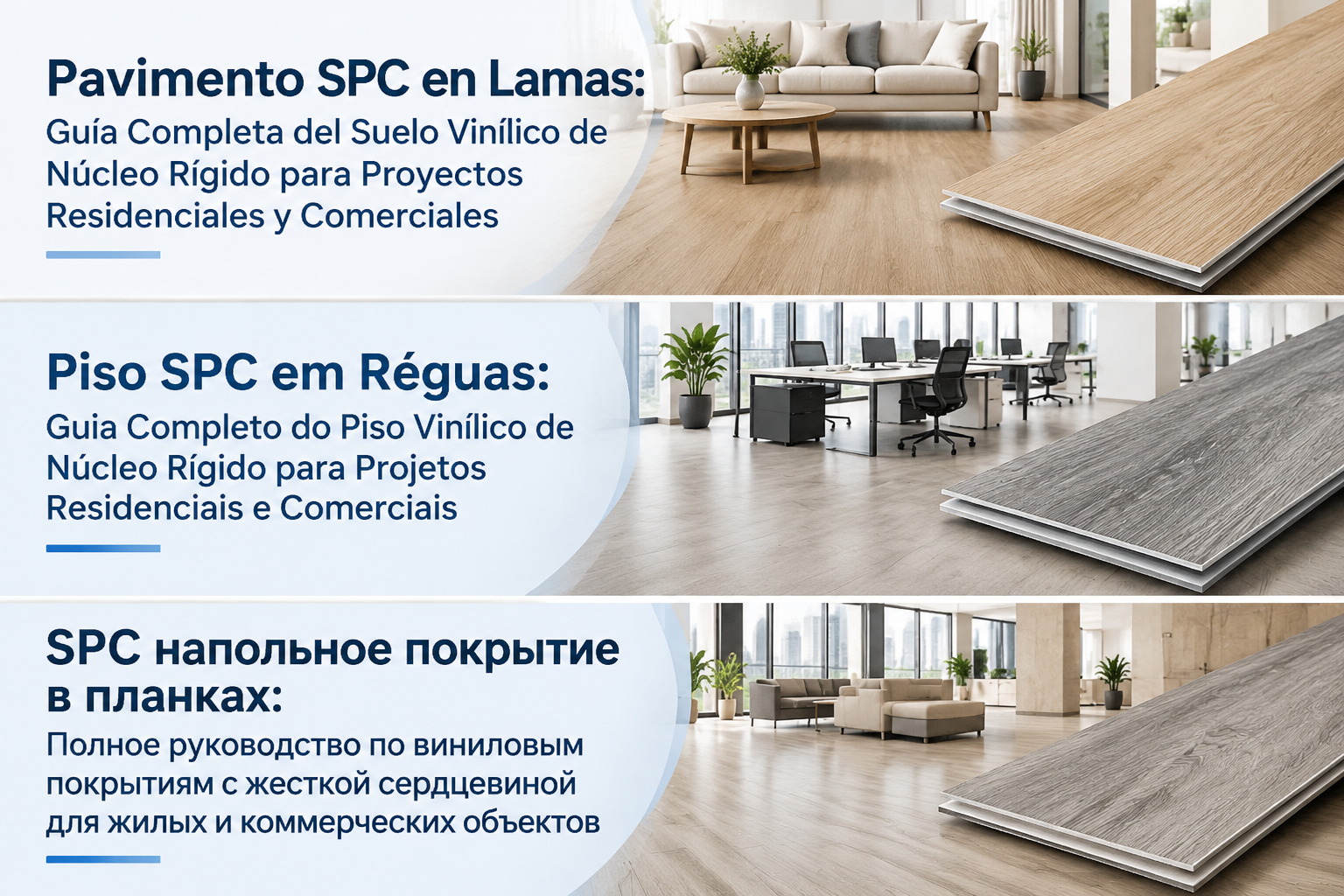
SPC Plank Flooring: A Complete Guide to Rigid Core Vinyl Flooring for Residential and Commercial Projects
SPC Plank Flooring: A Complete Guide to Rigid Core Vinyl Flooring for Residential and Commercial Projects
SPC plank flooring has become a popular choice in the global flooring market, offering a practical combination of durability, water resistance, dimensional stability, and modern design. Also known as Stone Plastic Composite or Stone Polymer Composite flooring, SPC is a type of rigid core vinyl flooring designed for residential renovations, commercial interiors, and various construction projects.
With its dense composite core and realistic wood and stone designs, vinyl SPC flooring provides an attractive alternative to traditional hardwood, laminate, and ceramic tiles.
But what makes SPC plank flooring different from other vinyl flooring products? What should buyers consider when choosing SPC flooring for their projects?
In this guide, we explore its structure, key advantages, applications, and important purchasing considerations to help distributors, contractors, and project buyers make informed decisions.
1. What Is SPC Plank Flooring?
SPC plank flooring is a type of rigid core vinyl flooring manufactured using a composite material that primarily combines calcium carbonate (limestone powder), PVC resin, and stabilizers.
Unlike traditional flexible vinyl flooring, SPC features a dense and rigid core that provides enhanced dimensional stability and resistance to everyday impact.
A typical SPC flooring plank consists of several layers:
-
UV Coating: A protective surface treatment designed to improve resistance to stains, scratches, and daily wear.
-
Wear Layer: A transparent protective layer that helps prevent surface damage from foot traffic, furniture, and regular use. Common thicknesses include 0.3 mm, 0.5 mm, and 0.7 mm.
-
Decorative Film Layer: A printed design layer that recreates the appearance of natural wood, stone, marble, and other decorative materials.
-
SPC Core Layer: The rigid composite core made from PVC resin, calcium carbonate, and stabilizing additives. It provides structural strength and dimensional stability.
-
IXPE or EVA Underlayment: An optional attached backing layer that helps reduce impact noise and improves underfoot comfort.
The combination of these layers makes SPC plank flooring suitable for a wide range of interior applications.
2. Key Benefits of Vinyl SPC Flooring
Why are more distributors, contractors, and property developers choosing vinyl SPC flooring? Its performance characteristics make it a competitive solution for many residential and commercial environments.
Excellent Water Resistance
The SPC core is highly resistant to water absorption, making it suitable for kitchens, bathrooms, living rooms, and other moisture-prone indoor areas.
However, the waterproof performance of an installed floor also depends on the locking system, installation quality, perimeter details, and subfloor conditions.
Strong Dimensional Stability
The dense stone-composite core helps SPC planks maintain their shape under normal indoor temperature and humidity conditions.
Compared with many flexible vinyl products, SPC flooring offers a firmer structure and good dimensional stability when properly installed.
Durable Surface Performance
SPC flooring is available with different wear layer thicknesses to meet different application requirements.
A suitable wear layer helps protect the decorative surface against daily abrasion, scratches, stains, and general foot traffic.
Convenient Click-Lock Installation
Many SPC products feature a click-lock installation system, allowing planks to connect without traditional adhesive.
This floating installation method can reduce installation time and simplify renovation work, provided the subfloor meets the manufacturer's requirements.
Comfortable and Quiet Underfoot
SPC flooring with an attached IXPE or EVA backing can help reduce impact sound and improve walking comfort.
This is particularly useful in apartments, offices, hotels, and other multi-story buildings.
Easy Daily Maintenance
SPC flooring does not require waxing or polishing. Regular sweeping and damp mopping with a suitable floor cleaner are generally sufficient for routine maintenance.
3. SPC vs. LVT vs. WPC Flooring: What Is the Difference?
SPC, LVT, and WPC are three commonly discussed types of vinyl flooring. Although they share some materials and decorative features, their core structures and performance characteristics are different.
| Comparison | SPC Flooring | LVT Flooring | WPC Flooring |
|---|---|---|---|
| Core structure | Stone-plastic composite | Flexible or semi-rigid vinyl | Wood-plastic composite |
| Core rigidity | High | Varies by product | Generally lower than SPC |
| Water resistance | Excellent | Excellent for vinyl material | Excellent for vinyl-based products |
| Underfoot feel | Firm | Flexible and comfortable | Softer and more cushioned |
| Installation | Click-lock or other systems | Glue-down or click-lock | Usually click-lock |
| Typical applications | Homes, offices, retail spaces | Residential and commercial interiors | Residential interiors |
SPC Flooring: A rigid core solution offering good dimensional stability and water resistance. It is suitable for many residential and commercial flooring projects.
LVT Flooring: A versatile vinyl flooring category available in different structures, including glue-down and click-lock products. It offers flexibility in design and installation.
WPC Flooring: Features a lighter, foamed composite core that generally provides a softer and more cushioned walking experience.
The best choice depends on the project's budget, installation conditions, expected foot traffic, and performance requirements.
4. Where Can SPC Plank Flooring Be Used?
One of the biggest advantages of SPC plank flooring is its versatility. Its decorative options and practical performance make it suitable for many indoor environments.
Residential Applications
SPC flooring is widely used in:
-
Living rooms and bedrooms
-
Kitchens and dining areas
-
Apartments and condominiums
-
Home offices and study rooms
-
Residential renovation projects
Wood-look SPC planks are especially popular for creating a warm and natural interior appearance.
Commercial Applications
For commercial interiors, SPC flooring offers a practical combination of appearance and everyday durability.
Common applications include:
-
Retail stores and shopping areas
-
Offices and meeting rooms
-
Hotels and hospitality spaces
-
Restaurants and indoor dining areas
-
Showrooms and reception areas
For commercial projects, buyers should pay particular attention to wear layer thickness, total plank thickness, surface treatment, and relevant performance certifications.
5. How to Choose the Right SPC Flooring
Selecting the right SPC plank flooring requires more than comparing prices and decorative patterns. Buyers should evaluate several technical specifications before placing an order.
Total Thickness
SPC flooring is available in different thicknesses, commonly ranging from approximately 4 mm to 8 mm, depending on the product construction.
Thicker products may offer different structural and installation characteristics, but total thickness alone does not determine flooring quality.
Wear Layer Thickness
The wear layer is an important factor when selecting SPC flooring.
Typical options include:
-
0.3 mm: Suitable for many residential applications.
-
0.5 mm: A common option for residential and commercial environments with higher foot traffic.
-
0.7 mm: Often selected for demanding commercial applications.
The appropriate specification depends on the expected traffic level and project requirements.
Click-Lock System
A reliable click-lock system is important for installation efficiency and long-term joint performance.
Buyers should evaluate locking strength, dimensional accuracy, connection quality, and compatibility with the intended installation method.
Surface Design and Texture
SPC flooring is available in a wide variety of designs, including oak, walnut, hickory, marble, and stone patterns.
Embossed surfaces and Embossed-in-Register (EIR) textures can create a more realistic appearance by matching the surface texture with the printed decorative pattern.
Attached Underlayment
Some SPC products include an IXPE or EVA backing layer.
This additional layer can improve sound insulation and walking comfort, particularly in apartments and multi-story buildings.
Environmental and Performance Certifications
For international projects, buyers should check the relevant product documentation and certifications.
Depending on the target market, these may include CE marking, FloorScore certification, low-VOC testing, fire classification, and other applicable standards.
Always confirm that the certificates and test reports correspond to the actual product being supplied.
6. SPC Flooring Installation and Maintenance Tips
Proper installation and regular maintenance are essential for achieving good long-term flooring performance.
Here are several important recommendations:
-
Prepare the subfloor: Ensure the installation surface is clean, dry, stable, and sufficiently level according to the manufacturer's instructions.
-
Check installation conditions: Follow the recommended temperature and acclimatization requirements for the specific product.
-
Leave expansion gaps: Follow the manufacturer's installation guidelines for perimeter clearances and expansion requirements.
-
Use suitable accessories: Select compatible skirting, transition profiles, and other installation accessories.
-
Clean regularly: Sweep or vacuum the floor to remove dust and abrasive particles.
-
Avoid excessive water: Use a damp mop and suitable cleaning products instead of leaving standing water on the floor.
-
Protect the surface: Use furniture pads to reduce scratches and avoid dragging heavy objects across the flooring.
Following the manufacturer's installation and maintenance instructions can help extend the service life of SPC flooring.
7. How to Choose a Reliable SPC Flooring Manufacturer
For international distributors, importers, contractors, and project buyers, choosing a reliable SPC flooring manufacturer is just as important as selecting the right product.
Before working with a supplier, consider the following factors:
-
Manufacturing capability: Check production equipment, manufacturing processes, and actual production capacity.
-
Product consistency: Ask about quality control procedures for thickness, dimensions, locking systems, and surface appearance.
-
Product customization: Confirm whether the supplier supports different thicknesses, wear layers, colors, textures, and packaging requirements.
-
Technical documentation: Request product specifications, test reports, and relevant certifications.
-
Sample availability: Evaluate physical samples before confirming large-volume orders.
-
Export experience: Work with a supplier familiar with international shipping, export documentation, and B2B order requirements.
A professional manufacturer should be able to provide not only competitive prices but also consistent product quality and dependable support throughout the purchasing process.
8. Explore SPC Flooring Solutions from KCCFLOR
At KCCFLOR, we focus on providing vinyl flooring and interior finishing solutions for international distributors, importers, contractors, and commercial project buyers.
Our product range includes SPC flooring, LVT flooring, homogeneous and heterogeneous PVC flooring, rubber flooring, and wall panel solutions.
We understand that different markets and projects require different flooring specifications. From wear layer thickness and plank dimensions to decorative designs and packaging, we support customers in finding suitable products for their specific requirements.
Whether you are sourcing SPC plank flooring for residential distribution, commercial developments, or renovation projects, our team is ready to assist with product information, samples, technical documentation, and quotations.
Looking for a reliable SPC flooring manufacturer in China?
Contact KCCFLOR to explore our SPC flooring collection and discuss your next flooring project.
Frequently Asked Questions About SPC Plank Flooring
1. Is SPC plank flooring completely waterproof?
The SPC core itself is highly water-resistant and does not readily absorb water. However, the waterproof performance of the complete installed floor also depends on the joints, installation method, and perimeter sealing.
2. What is the difference between SPC and regular vinyl flooring?
The main difference is the core structure. SPC flooring uses a rigid stone-plastic composite core, while traditional flexible vinyl flooring generally has a more flexible structure. This affects rigidity, installation characteristics, and underfoot feel.
3. Is SPC flooring suitable for commercial projects?
Yes. SPC flooring is used in many commercial environments, including offices, retail stores, hotels, and showrooms. Buyers should select the appropriate wear layer, total thickness, and product specifications according to the expected traffic level.
4. How thick should SPC flooring be?
Common SPC flooring thicknesses range from approximately 4 mm to 8 mm. The ideal thickness depends on the application, installation conditions, and overall product construction.
5. Does SPC flooring require special maintenance?
No special waxing or polishing is normally required. Regular sweeping and damp mopping with suitable cleaning products are generally sufficient.
6. Can SPC flooring be installed over existing tiles?
In many cases, SPC flooring can be installed over existing tiles if the surface is stable, clean, dry, and sufficiently level. The manufacturer's installation requirements should always be followed.
7. Is SPC flooring suitable for underfloor heating?
Some SPC products are compatible with underfloor heating systems. However, buyers should confirm the manufacturer's maximum temperature limits and installation requirements before use.
Waterproof Click-Lock SPC Flooring – Formaldehyde-Free Rigid Vinyl SPC Flooring for Residential Renovation and Commercial Engineering Projects
Related Article
